Friday, May 23, 2014

European Parliament election begins, and Ukraine's Presidential Election looms

There has been a great deal of anticipation of the outcome of this year's EU Parliament elections, turning around the presidential battle between Juncker and Schulz, and whether the Euro-skeptic parties will come out on top.  Here's a few articles of interest:

Six Seminal Moments in Britain's Euroskepticism

In the Netherlands, Geert Wilders' Freedom Party has underperformed expectations:


The latest from the German Marshall Fund Blog looks at the implications of this weekend's election:

Four Lessons from the European Parliamentary Election Campaigns

Meanwhile, the EU continues to focus on issues surrounding the Euro and banking crisis:
Ukraine's presidential will be held this Sunday, despite violence continuing in the Eastern part of the country. The Center for Strategic and International Studies has developed a very helpful timeline of the crisis in Ukraine:

Monday, May 19, 2014

Equality Bodies in the fiscal crisis -- from the new book: Legislating Equality

Today's post is drawn from the new book Legislating Equality: The Politics of Antidiscrimination Policy in Europe by Terri E. Givens and Rhonda Evans Case (Oxford University Press, May 2014). You can download the first chapter at Oxford University Press - UK

In October of 1999 politicians around the European Union (EU) were stunned by the success of Jörg Haider’s far right Freedom Party. When Haider’s party became part of the Austrian government in early 2000, the other EU countries responded with diplomatic sanctions and within a few months would pass the Racial Equality Directive (RED), a measure which would require all 15 member states (and future members) to pass antidiscrimination policy into national law. Ten years later, despite some initial success with the development of national level equality bodies, many EU governments were slashing funding and moving once-independent entities into larger human rights bodies, thereby diluting their influence. The institutions created by the RED were under fire partially because of the ongoing fiscal crisis, but also due to political pressure. The RED and consequent Equal employment and Gender equality directives were a set of policies which developed along with European integration in the 1990s, but ran into the integration slowdown after enlargement in the mid-2000s, a fiscal crisis, and a lack of prioritization by mostly conservative governments.

In our book, Legislating Equality: The Politics of Antidiscrimination Policy in Europe, we examine the development and implementation of the RED in Europe. Two factors played an important role for the development of antidiscrimination policy in the EU. The first is racist anti-immigrant sentiment, and the second is Left vs. Right politics, i.e. the rise of the radical right as a catalyst for the passage of legislation and Left support for antidiscrimination policy. However, these policy developments were also dependent upon the process of Europeanization – as the European Union developed, political opportunities developed which allowed the issue of racism and antidiscrimination policy to move forward as a policy issue.

The RED’s most visible accomplishment was the creation of national equality bodies tasked with combating discrimination. The equality bodies have three principal goals: to assist and support victims to pursue complaints, to conduct independent surveys, and to publish independent reports on discrimination. The European Commission against Racism and Intolerance (ECRI) delineated the following competencies as central to a body’s success:

  • Providing aid and assistance to victims, including legal aid, and (where appropriate) to ensure victims have recourse to the courts or other judicial authorities. 
  • Monitoring the content and impact of legislation intended to combat racial discrimination, and recommending, where necessary, improvements to this legislation. 
  • Advising policymakers on how to improve regulations and practices. 
  • Hearing complaints concerning specific cases of discrimination and seeking resolutions either through mediation or through binding and enforceable decisions. 
  • Sharing information with other national and European institutions tasked with promoting equality. 
  • Issuing advice on best practices of anti-discriminatory practice. 
  • Promoting public awareness of discrimination and disseminating pertinent information (European Commission against Racism and Intolerance, 1997). 
By 2008 most countries in the EU, including those that had recently joined, had passed laws implementing the EU’s equality directives. In the first few years after the transposition of the Equal Treatment Directives there was growth in both the number and staffing of the equality bodies and in some cases success in “naming and shaming” corporations and other entities for discrimination. The equality bodies were also somewhat successful in bringing awareness to the issues around discrimination. However, by the ten year anniversary of the passage of the RED in 2010 it was clear that both politics and the European fiscal crisis were having a negative impact on the equality bodies.

By 2010, antidiscrimination policy enforcement was put on the backburner in most countries.  Britain’s Labour government decided to merge the long-standing Commission for Race Equality into the Equality and Human Rights Commission, potentially blunting its impact in the area of racial discrimination. In France, the Haute Autorité de Lutte contre les Discriminations et pour L’Egalité (HALDE) became an important contact point for those who felt discrimination. However, in 2011, the French Assembly passed a law that folded the HALDE into a larger human rights entity, the Defenseur des Droits. Both staff from the HALDE and academic commentators expected this change to reduce the visibility, effectiveness and power of the HALDE, particularly in the area of racial discrimination.

The global economic downturn has been perceived to be a “trigger” for increased intolerance and discrimination against migrants and members of minority groups, exacerbated by budget cuts and waning political will to combat it. However, this is likely a temporary spike that does not yet point to an increase in institutional discrimination. This does point to a need for governments to act quickly: the right measures need to be put in place during countries’ recovery period from the crisis to stave off a worsening of the situation of migrants and minorities—groups already at risk.


In light of these challenges, the European Union’s antidiscrimination priority for the next decade should not be to create more legislation or more institutions; instead, the EU needs to strengthen the ones it already has. European governments, EU institutions, and civil society partners will continue to evaluate what is working and what is not, and reinforce the existing structures.

Tuesday, April 8, 2014

French Elections and the aftermath

France held its municipal elections on March 30th.  Francois Holland's Socialists were not expected to perform well, and they met those expectations.  After the election debacle, President Hollande reshuffled his cabinet, hoping to mitigate some of the damage:

French reshuffle may loom after Hollande's Socialists routed in local elections

François Hollande.
There was a great deal of focus on the success of the far right National Front, but the party still has some way to go to be considered a mainstream party:
Marine Le Pen

Saturday, March 29, 2014

Obama in Europe, Ukraine issue at top of agenda

President Obama's trip to Europe had been planned, but the timing was important for the situation in Ukraine. This overview in the Washington Post's Wonkblog lays out the critical issues going forward:

Wonkbook: How the crisis in Ukraine is shaking up Obama’s trip to Europe

Obama emphasized unity between the U.S. and Europe, although differences remain, particularly on the issue of military spending.

The sanctions regime will take time to impact Russia, as explained by former LBJ faculty member James Lindsay:

In the latest news, Secretary of State John Kerry is returning earlier than planned to Europe, to explore new prospects for diplomacy...
Ukraine highlights the dangers ahead for the EU:

Ukraine Upheaval Highlights E.U.’s Past Miscalculations and Future Dangers


Sunday, March 16, 2014

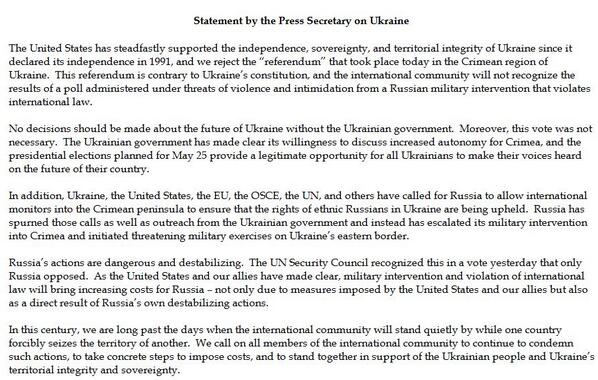
Ukraine - Background and Developments up through the referendum in Crimea, March 16, 2014


Timeline of developments in Ukraine since it declared independence from Russia in 1991

BBC Ukraine Timeline

Some links with streaming updates:

Wall Street Journal Streaming News on Ukraine

Yannis Koutsomitis Storify: Ukraine after Regime Change

CNN: Crisis in Ukraine

The referendum on Crimea took place today with the expected outcome of the referendum in Crimea:

BBC on the Referendum in Crimea

The Ukrainian Prime Minister sent a warning to Russian separatists and the outcome of the referendum could lead to a loss of resources for Crimea - and a painful switch over to dependence on Russia:

Ukraine Prime Minister sends warning to Pro-Russian separatists


Meanwhile in Moscow, thousands protested, including members of Pussy Riot:

Tens of Thousands Protest Putin

"Don't believe it when they say that we are few, that we are weak," said Nadezhda Tolokonnikova, a member of Pussy Riot, during the rally. "Together we will change this country."


From the White House:


Embedded image permalink

Thursday, February 13, 2014

Putting the Swiss Vote in Context: UK and Switzerland ready to take action on EU migrants - Germany in the middle?

The big news on immigration this week was a Swiss vote to curb migration:

Swiss Voters Narrowly Approve Curbs on Immigration 

The vote was immediately denounced by the EU and some member countries, and could threaten Switzerland's relationship with the EU.  Although Switzerland is not a member of the EU, the country has signed onto various treaties related to trade and the free movement of labor, that will be impacted by the new law. However, this vote needs to be put in a broader context.  In the past, the focus of most EU member states was on controlling immigrants from outside of the EU. The boatloads of refugees landing on the Italian island of Lampedusa was a symbol of illegal immigration and refugee flows that were a growing concern.  However, there has also been a growing concern about immigration from other EU member states, particular those with lower incomes and welfare benefits

Swiss immigration vote shows loss of trust in business elite: minister

The BBC looks at concerns raised by the vote:

EU neighbours regret Swiss vote for immigration quotas

On January 1, 2014, Romania and Bulgaria gained the right of free movement of labor within the EU.  In advance of this development, UK Prime Minister David Cameron laid out his concerns regarding immigration from those countries, and changes his government would make to the welfare system.  However, critics charged that the changes would have little practical effect, and even the government focused on the idea that they would "send a message"

EU migration: David Cameron says his welfare changes 'send a message' to Romania and Bulgaria. Is that enough?

Germany will block David Cameron's attempt to restrict immigration by rewriting the EU treaty's right to free movement

More recently Cameron has modified his tone as an immigration bill works its way through Parliament:

David Cameron says EU immigration at 'reasonable level' 

Although there have been calls from conservative politicians in Germany to pursue similar measures, the German government has been critical of Cameron's attempts to pursue changes to free movement:

German foreign minister: Cameron 'damaging Europe' with call for immigration limits

German minister dismisses fears of immigration from eastern Europe


EU Employment Commissioner Laszlo Andor has also been critical of Cameron:

EU tells Britain: Don't pander to prejudice on immigration

One of the ironies of the current situation is that the unease of foreigners is not limited to Bulgarians and Romanians:

Germans in Switzerland uncertain of future

Meanwhile, Britain's Immigration Minister resigned after revealing that his housekeeper was an undocumented immigrant.


Saturday, February 1, 2014

Euro Crisis disappears from the headlines, Ukraine Crisis continues, Benefits for migrants raises issues in Germany

From the BBC "Whatever happened to the eurozone crisis?"
http://www.bbc.co.uk/news/world-europe-26004585

"Merkel Warns of ‘Deceptive Calm’ as Euro Crisis Risk Remains"
http://www.bloomberg.com/news/2014-01-29/merkel-cautions-against-deceptive-calm-as-crisis-risk-remains.html

Ukraine Rivals meet at Munich Summit:
http://www.bbc.co.uk/news/world-europe-26004585
Ukrainian Foreign Minister Leonid Kozhara (left) and opposition leader Vitali Klitschko
Activists claims of torture put pressure on Ukrainian Government
http://www.bbc.co.uk/news/world-europe-26004585

Protestors find ways to stay warm in the freezing cold


Immigration from Romania and Bulgaria leads to controversy in Germany over unemployment benefits: http://www.spiegel.de/international/europe/eu-commissioner-criticizes-tough-german-stance-on-immigrant-benefits-a-946373.html

From Exclusion To Integration